# Benchmark with pgvector
> In this section, we compare VectorChord with pgvector, a PostgreSQL extension that provides vector similarity search capabilities. We will focus on four key met
---
LLMS index: [llms.txt](/llms.txt)
---
In this section, we compare VectorChord with pgvector, a PostgreSQL extension that provides vector similarity search capabilities. We will focus on four key metrics: QPS (Queries Per Second), Recall@100, Index Building Time, and Insertion Time. If you are interested in the details of our implementation, please refer to our blog [Vector Search Over PostgreSQL: A Comparative Analysis of Memory and Disk Solutions](/blog/post/vector-search-over-postgresql-a-comparative-analysis-of-memory-and-disk-solutions/).
## QPS & Recall
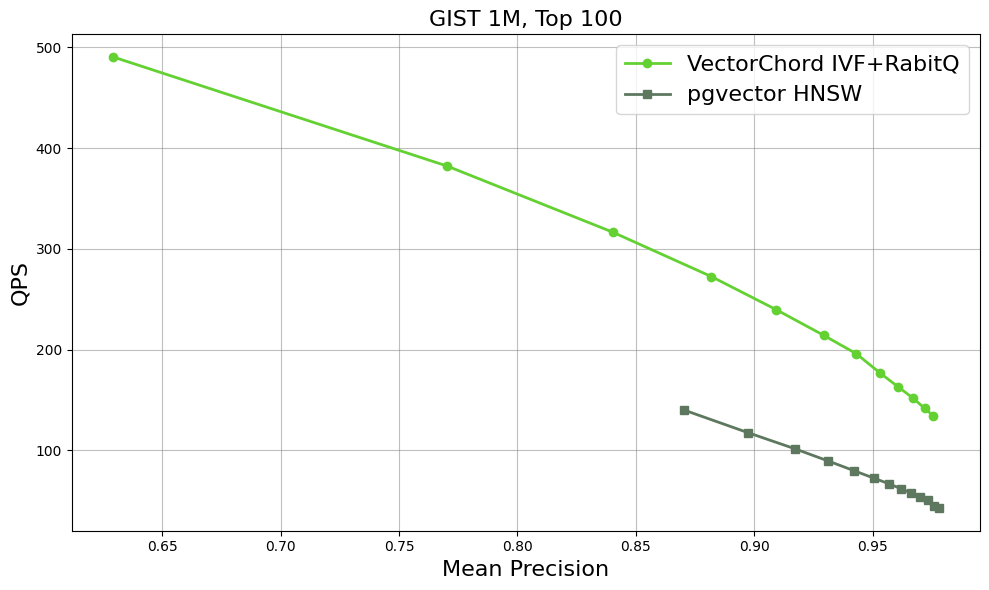 Here are some initial benchmark results for the GIST dataset, which consists of 1 million vectors in 960 dimensions. With equivalent recall, VectorChord's QPS could be twice that of pgvector. More details will be provided in the Benchmark section.
## Index Build Time & Insert Time & Query Completion Time
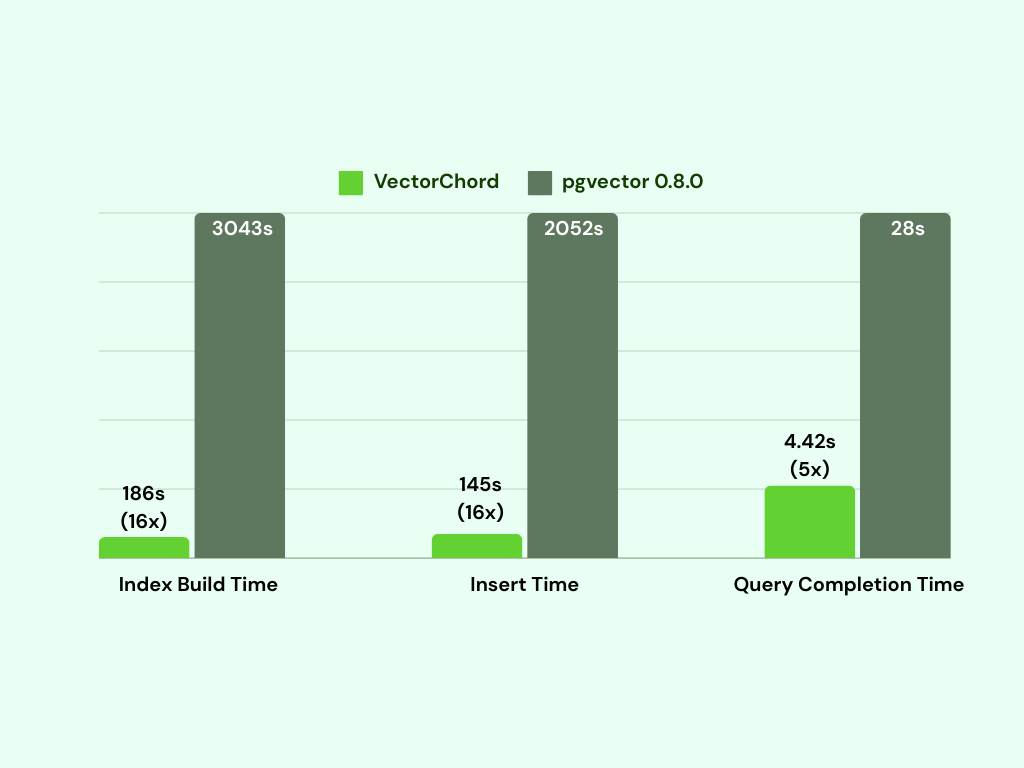 VectorChord takes 186 seconds to build the index by utilizing a separate machine for KMeans clustering, making it **16 times faster than pgvector**. Additionally, the insert time is also 14 times faster than that of pgvector. As we know, indexing is the most resource-intensive part of vector databases, requiring significant computation and increasing the demand for CPUs and memory. By utilizing a more capable machine to build the index and then importing it to a smaller machine for querying, it becomes possible to support billions of vectors on a single machine.